Verified November 5, 2026. Checked against current City of Toronto, City of Mississauga and City of Brampton pages on sidewalk repair, boulevard maintenance, City-owned trees and claims.
Short answer: In Toronto, Mississauga and Brampton, the City owns the sidewalk, the curb and the street trees on the boulevard in front of your house, and the City repairs them. You report a cracked or heaving sidewalk, a broken curb or a problem street tree through 311, and the City inspects and schedules the work. What you do have to look after is the grass strip itself: all three cities expect the homeowner to cut the grass and keep the boulevard tidy, even though the City owns that land. You cannot prune or remove a City tree yourself.
What the boulevard is, and who owns it
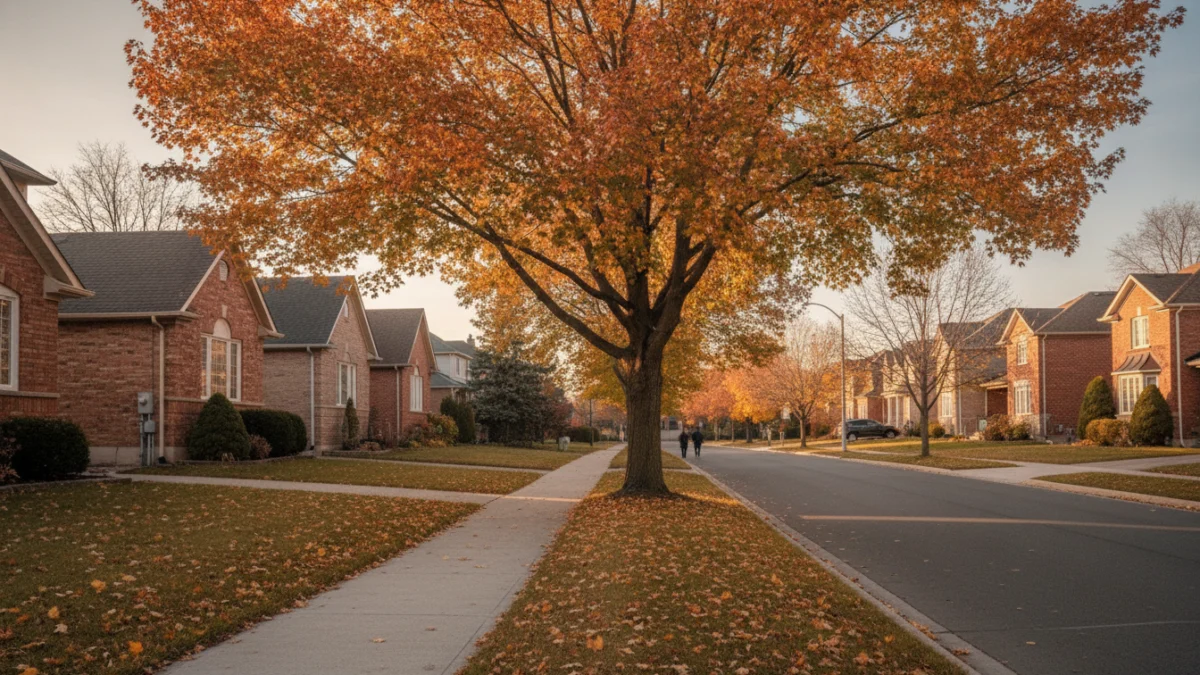
Most GTA homes do not own the land right up to the curb. Between your front property line and the road there is usually a strip of City land called the boulevard, or road allowance. It often holds the sidewalk, a grass strip, a street tree, a hydrant or a utility box, and the end of your driveway.
Brampton describes it as “the land closest to the road between your front or side lot line and the paved street,” and says plainly: “While this land is owned by the City, it is the property’s owner’s responsibility to properly maintain it.” Toronto and Mississauga follow the same idea. The City owns and repairs the hard parts and the trees. The owner next door keeps the strip looking cared for.
Your survey shows exactly where your lot ends. Many owners are surprised to find that the front lawn they mow is partly City land, which matters if you plan to add a garden wall, widen a driveway or plant a tree near the sidewalk.
Who looks after what: quick table
| Item | Toronto | Mississauga | Brampton |
|---|---|---|---|
| Cracked or uneven sidewalk | City. Report through 311 | City. Inspection within 3 business days of a report | City. Repairs scheduled from staff inspections and 311 reports |
| Damaged curb | City. Report through 311 | City. Inspection within 3 business days | City. Report through 311 (Potholes and Roads) |
| Street tree pruning and removal | City (Urban Forestry) | City (Forestry) | City (Urban Forestry) |
| Tree inspection after a request | No fixed time published | Within 30 business days | About 90 business days |
| New or replacement street tree | City replaces removed City trees where site allows | Free on request | On request through 311 |
| Grass cutting and weeds on the boulevard | Homeowner (Municipal Code Ch. 743) | Homeowner, in practice | Homeowner |
| Branches near hydro lines | Toronto Hydro | Call 311 to confirm | Call 311 to confirm |
Mississauga’s pages reviewed for this guide describe boulevard gardens but do not name a boulevard grass by-law, so “in practice” reflects how the strip is maintained, not a quoted rule.
Cracked sidewalks and broken curbs
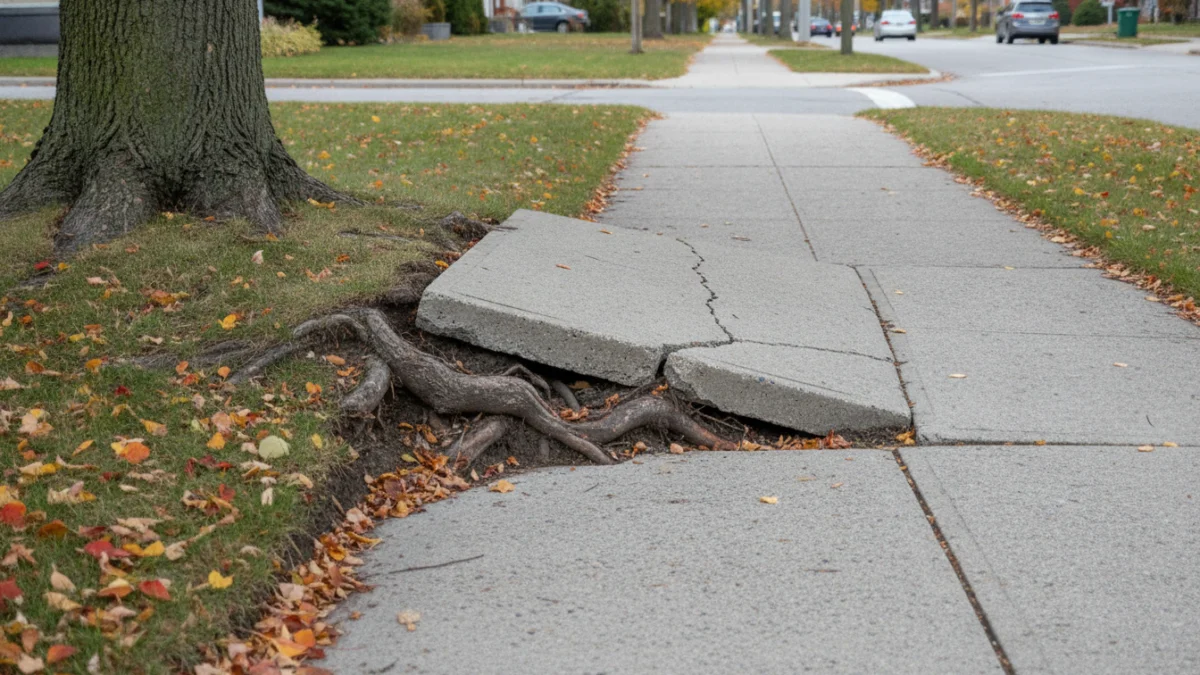
A heaved slab, a deep crack or a curb chipped by a snowplow is the City’s job, not yours. You do not have to hire anyone or pay for the repair. What helps is reporting it clearly, with an exact location and a photo if the online form allows one.
Toronto
Toronto’s road maintenance page tells residents to “submit a service request to report damage or debris removal from a boulevard, sidewalk, culvert, curb, ditch, catch basin or driveway.” Through 311 you can report minor sidewalk damage, a damaged curb, a curb height adjustment, water ponding on a sidewalk, damaged asphalt on a City boulevard and a sinking road or boulevard.
The City says “sidewalks are inspected regularly as part of the City’s road inspection program,” and that “rather than replacing an entire sidewalk, the City replaces only the sidewalk bays that are in the greatest need of repair.” Sidewalk replacement is often timed with planned road work. Toronto does not publish a fixed repair time on these pages.
Mississauga
Mississauga is the most specific of the three. The City says it “regularly monitors sidewalks throughout the year” for:
- raised sections with a ledge more than two centimetres high
- cracks more than two centimetres wide
- missing pieces
- sunken areas that hold water for more than 24 hours
If you see one of these, report it online or call 311 (905-615-4311 from outside the city) if it is a safety concern. The City says it will “do an inspection within three business days and make the area safe,” and if more work is needed, “we’ll add it to our job list.” Before construction starts, nearby homes get a hand-delivered Construction Notice. Curb damage follows the same process and the same three-business-day inspection.
Two exceptions: the online form is for sidewalks that are not part of a new subdivision, and a damaged sidewalk on private property is the property owner’s problem.
Brampton
Brampton says repairs “to potholes, bridges, sidewalks, etc. are scheduled and performed based on staff inspections and reports from the public.” Report through 311 (905-874-2000 from outside the city) or online in the Potholes and Roads category. Roads staff also take email at roads@brampton.ca. Brampton does not publish an inspection frequency or repair time on its road maintenance page.
Boulevard trees: pruning, removal and new trees
The tree between the sidewalk and the road is usually City property, even if you have watered and raked under it for 20 years. That means the City decides when it is pruned or removed, and you need permission to do any work on it yourself. Our guide to cutting a neighbour’s tree branches covers the rules for private and boundary trees.
Toronto
Toronto says it “owns and is responsible for the maintenance of trees on City property,” including more than 600,000 street trees. Under its Area Street Tree Maintenance program, the goal is to prune every City street tree “approximately once every seven years.” Outside that cycle, the City prunes only if it decides the work is needed.
- Requests: contact 311 or submit an online tree request. The City inspects after a request is created and leaves an inspection card at the nearest home. It notes that timelines “may be delayed due to the current work load.”
- Doing it yourself: not allowed. You can apply to have your own arborist work on a City tree at your cost, with a certificate of insurance and an arborist agreement. The City approves it only if the work meets its pruning standards.
- Removal: the City removes a tree when it is “dead, structurally hazardous or no longer viable.” Otherwise you would need an application to injure or destroy the tree, with fees, and it can be refused.
- Replacement: “Every City-owned tree that is removed is required to be replaced with a new tree, where site conditions allow.”
- Who owns a tree on the line: if more than half of the base is on private land, it is the owner’s tree. If more than half is on the road allowance, it is the City’s.
- Hydro lines: branches on or near wires along the road go to Toronto Hydro.
Mississauga
Mississauga takes online requests to prune “City-owned trees on the City boulevard of a residential or commercial property.” The City will “complete an inspection within 30 business days” and leave a notice at your door with the work needed and rough timing. For a tree that poses a safety risk, call 311 instead.
The City also plants new and replacement trees on City property “free of charge.” The old stump must be removed first, which is a separate request. Staff inspect within 30 business days, planting happens in spring, summer and fall, and City contractors water new street trees for two years. You also need a permit to injure a City tree, so do not cut roots or branches of a boulevard tree on your own.
Brampton
Brampton’s Urban Forestry team “is responsible for the planting, maintaining, and removing trees on public property,” including boulevard street trees. Requests go through 311 under Pruning and Inspections, Tree Removal or Damage, Request New/Replacement Tree, or Report Dead or Unhealthy Tree. Every request includes an inspection, “completed approximately 90 business days from the initial request,” and the inspector leaves a door hanger when it is done.
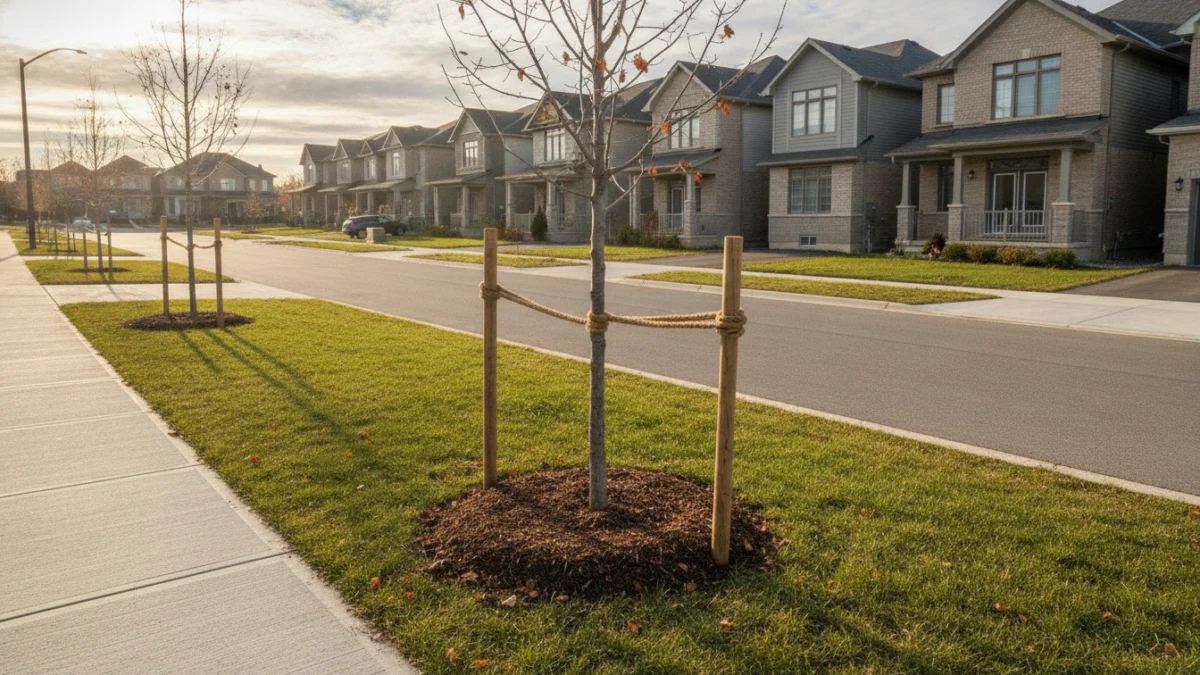
In new subdivisions, the developer or builder plants the street trees, and “a 2-year warranty is placed on a street tree from time of planting.” After that, the City takes over. If a young street tree on a new street dies, ask 311 whether it is still under the builder’s warranty.
For removal permits on private trees in all three cities, see our tree removal permit guide.
What the homeowner has to do
This is the part people get wrong. The City repairs the boulevard, but the everyday upkeep is on you.
- Toronto: “Property owners are responsible for maintaining the municipal boulevard adjoining their property,” including cutting grass, removing weeds and general upkeep. Owners who do not may face enforcement under Chapter 743 of the Municipal Code, including the City’s costs to do the work. Raking or blowing leaves onto the road or sidewalk is not allowed and the City lists a $200 fine for it.
- Mississauga: the City lets residents plant a garden “on the section of land between your property line and the road or sidewalk,” under its boulevard garden rules. Check those rules before you plant anything tall near a driveway or corner.
- Brampton: owners must cut the grass, remove weeds, keep the strip clear of garbage, debris, animal waste and trip hazards, and fill in holes or damage. Construction bins, landscaping materials, non-City plantings and sports nets on the boulevard count as obstructions, and pushing snow, leaves or yard waste into the street can lead to charges.
In winter, the sidewalk itself has its own rules, which differ a lot across the three cities. Our guides to who clears the sidewalk in front of your house and who clears the snow windrow cover them.
Utility cuts, contractors and damage claims
Utility work
If a gas, telecom or hydro crew digs up the sidewalk or boulevard, Toronto says “they are responsible for restoring the affected road, sidewalk, curb or boulevard to City standards.” If a patch is left unfinished, Toronto’s 311 accepts requests to inspect a utility cut repair.
Your own contractor
Work that occupies or affects the road allowance can need a permit. Mississauga says construction or utility work that will “obstruct, occupy or close a city road, sidewalk or boulevard” may require a road occupancy permit, and work cannot start until it is issued. Bins and storage containers on the road are covered too. If you are planning a wider driveway, our Mississauga driveway widening guide explains the curb cut rules. None of the city pages reviewed spell out who pays when a private contractor damages a sidewalk, so ask your contractor to confirm permits and insurance in writing before work begins.
If you trip or your property is damaged
If you are hurt on a damaged City sidewalk, or a City tree falls on your car or house, you can make a claim. Brampton’s claims page explains the key deadline: “In some situations, you are required to place the City on notice within 10 days of the incident. The Municipal Act requires that the City receives notification in writing.” Brampton asks for the date, time and exact location, a description, your signature and supporting photos or estimates, sent to the City Clerk’s Office. It acknowledges claims within one to two weeks and gives a final response within 45 to 60 days.
Brampton also notes that the City pays only if it is “found legally liable,” meaning you must show a negligent act or omission. Toronto and Mississauga have their own claims processes; we could not verify their pages for this update, so check with 311 and act quickly.
This is general information, not legal advice. For an injury or a large claim, speak with an Ontario lawyer or paralegal, and contact your own insurer.
What buyers and sellers should check
A big street tree and a tidy boulevard add a lot to curb appeal, but they come with a few questions worth asking before you firm up an offer:
- Where is the lot line? Check the survey so you know how much of the front yard is City boulevard.
- Is the street tree healthy? Look for dead limbs, lifted sidewalk slabs near the trunk, or a stump that was never replaced. A 311 request can get an inspection started after you move in.
- Anything built on the boulevard? Garden walls, raised beds or interlock extending past the lot line can be a by-law issue for the next owner.
- Open City work? Ask the seller whether a sidewalk or tree request is already open, or whether a construction notice was delivered.
Ready to look at homes on tree-lined streets? Start your home search with Local Toronto. Selling, and curious how your lot and street compare? Get a free home evaluation.
FAQ
Who fixes a cracked sidewalk in front of my house in Toronto, Mississauga or Brampton?
The City does. Sidewalks on the boulevard are City property in all three cities. Report the damage through 311 or the City’s online form. Mississauga inspects within three business days and makes the area safe. Toronto and Brampton schedule repairs from inspections and public reports.
Do I have to cut the grass on the boulevard?
Yes, in practice. Toronto and Brampton both say the property owner must maintain the boulevard next to their home, including cutting grass and removing weeds, even though the City owns the land. Toronto can enforce this under Municipal Code Chapter 743.
Can I prune the City tree in front of my house?
No, not on your own. Ask the City to prune it through 311. Toronto lets you apply to hire your own arborist at your cost with City approval, insurance and an arborist agreement. Mississauga requires a permit to injure a City tree.
How long does it take for the City to inspect a boulevard tree?
Mississauga aims to inspect within 30 business days of a pruning or planting request. Brampton says about 90 business days. Toronto does not publish a fixed time and says workload can cause delays.
Can I get a free street tree?
Mississauga plants new and replacement trees on City property free of charge once any old stump is removed. Brampton takes new or replacement tree requests through 311. Toronto replaces City trees it removes where the site allows.
What should I do if I trip on a damaged City sidewalk?
Get medical care first, take photos and note the exact location, then notify the City in writing quickly. Brampton notes that the Municipal Act can require written notice within 10 days. Speak with a lawyer or paralegal about a claim.
Sources
- City of Toronto, Road maintenance (modified August 20, 2026) and Sidewalks and roads repair (modified July 31, 2026).
- City of Toronto, Leaf, grass, weed and boulevard maintenance (modified July 16, 2026).
- City of Toronto, City-owned tree maintenance (modified July 11, 2026).
- City of Mississauga, Report sidewalk damage and Report curb damage (both modified October 1, 2026).
- City of Mississauga, Request a tree pruning and Request a new or replacement tree (both modified October 1, 2026).
- City of Mississauga, Roads and sidewalks and Road occupancy permit.
- City of Brampton, Boulevard maintenance and highway obstruction.
- City of Brampton, Road maintenance programs.
- City of Brampton, Tree services.
- City of Brampton, Insurance claims.
Images: AI-generated illustrations created for this guide. They do not show real properties.
This article is general information about municipal services in Toronto, Mississauga and Brampton as published in November 2026. It is not legal advice. Confirm details with 311 in your city.
Local Toronto, HomeLife Landmark Realty Inc., Brokerage.