Verified November 21, 2026. Prices from TRREB’s October 2026 Market Watch; 2026 tax rates from the Town of Aurora; GO station and construction details from GO Transit and Metrolinx; planning details from the Town of Aurora; history from the Town’s museum pages, the Ontario Heritage Trust and The Canadian Encyclopedia.
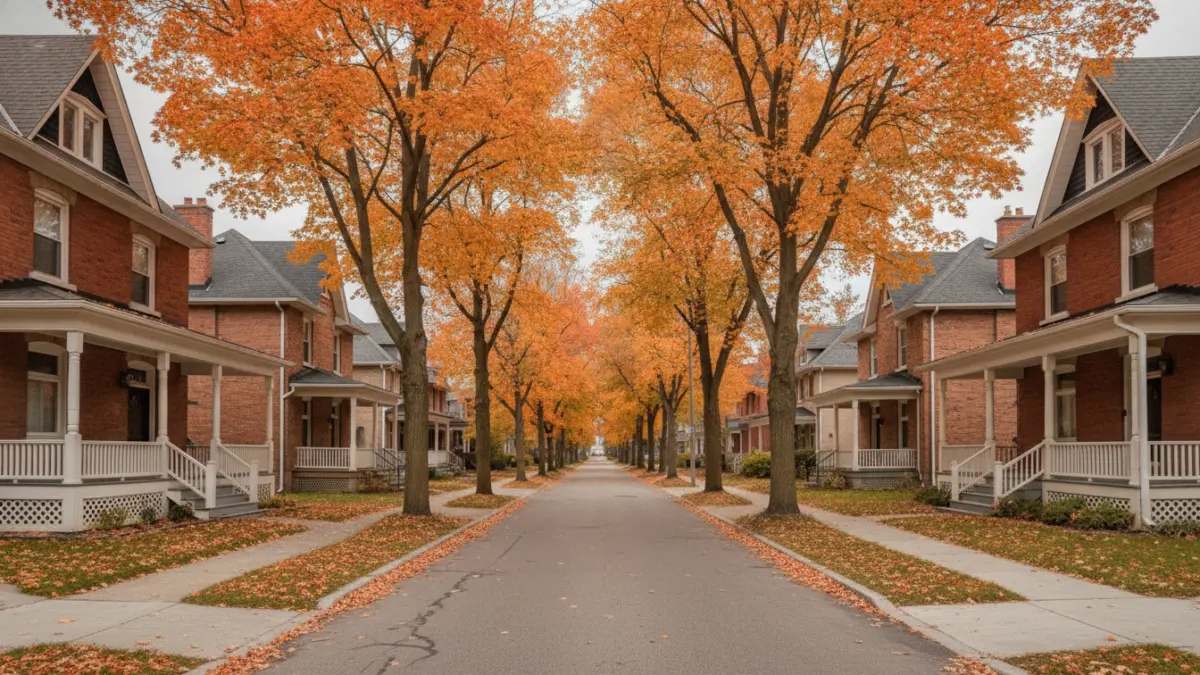
Aurora is a town of about 62,000 people in the middle of York Region, on Yonge Street between Richmond Hill and Newmarket. It has a historic downtown at Yonge and Wellington, a GO station on the Barrie line, a new cultural hub called Aurora Town Square, and a heritage district of 19th century houses.
The short version: TRREB reports Aurora as its own municipality, so the price figures here are for Aurora itself. In October 2026, Aurora homes of all types sold for an average of $1,170,302 and a median of $1,131,500 across 50 sales. Detached houses averaged $1,395,203. The MLS Home Price Index benchmark for Aurora was $1,096,900, down 7.37% from a year earlier. Buyers pay only the Ontario land transfer tax, and the 2026 residential tax rate is 0.873953%. Aurora GO is in the middle of a rebuild that adds a second track, with major work expected to finish in December 2027.
Where Aurora is
Aurora borders Newmarket to the north, Whitchurch-Stouffville to the east, Richmond Hill to the south and King Township to the west. Yonge Street runs north to south through the middle of town, and Wellington Street is the main east to west road. The old downtown sits where the two meet.
The Canadian Encyclopedia lists Aurora’s population at 62,057 in the 2021 census, up from 55,445 in 2016. Most of the town’s housing sits in subdivisions that spread out from the older streets around the downtown core, with larger lots and estate homes toward the edges of town.
For buyers, the main thing to know is that Aurora is a single TRREB municipality. Monthly figures are reported for the whole town, not for separate neighbourhoods, so the Aurora figure mixes older homes near downtown with newer subdivisions and estate lots.
From Machell’s Corners to Aurora
According to the Town of Aurora’s museum history, the first merchant at the Yonge and Wellington crossroads was Richard Machell, and the settlement became known as Machell’s Corners. Its post office was called Whitchurch. Charles Doan, the first postmaster, renamed it Aurora after the Roman goddess of the dawn, and the new name took effect in 1854.
The railway made the town. On May 16, 1853, the Ontario, Simcoe and Huron Union Railroad ran the first steam train in Canada West from Toronto to Machell’s Corners, a milestone marked by an Ontario Heritage Trust plaque. In 1859 Joseph Fleury opened the Aurora Agricultural Works, which made farm equipment. Aurora became a village in 1863, with Doan as its first reeve, and a town on January 1, 1888.
The Canadian Encyclopedia notes that Aurora’s 1874 drill shed is Ontario’s oldest purpose-built armoury still in use. Members of the local GO construction liaison committee have pointed out that 2028 will mark 175 years of train service to Aurora.
What homes sell for
| Home type | Sales | Average price | Median price | New listings | Active listings | Sale to list |
|---|---|---|---|---|---|---|
| All home types | 50 | $1,170,302 | $1,131,500 | 164 | 294 | 98% |
| Detached | 32 | $1,395,203 | $1,282,500 | 106 | 180 | 98% |
| Freehold townhouse (att/row) | 5 | $955,578 | $900,000 | 19 | 36 | 96% |
| Semi-detached | 3 | $949,567 | $980,000 | 7 | 13 | 94% |
| Condo townhouse | 8 | $638,500 | $638,000 | 15 | 33 | 99% |
| Condo apartment | 2 | $567,000 | $567,000 | 17 | 32 | 98% |
| January to October 2026, all home types | 542 | $1,195,942 | $1,110,000 | 1,623 | not reported | 97% |
A few things help read these numbers. Detached houses made up 32 of the 50 October sales, so the all-types average mostly reflects detached prices. The semi-detached, townhouse and condo rows rest on very few sales, from two to eight, so treat them as a rough guide only. The year-to-date figures, built on 542 sales, are steadier. TRREB’s October report also showed 5.0 months of inventory in Aurora and an average of 39 days on market, which gives buyers time to compare homes and negotiate.
| Benchmark type | Benchmark price | Change from October 2025 |
|---|---|---|
| Composite | $1,096,900 | -7.37% |
| Single-family detached | $1,290,800 | -7.28% |
| Single-family attached | $903,100 | -6.97% |
| Townhouse | $738,600 | -11.74% |
| Apartment | $493,900 | -13.96% |
The benchmark tracks a typical home rather than the mix of homes that happened to sell in a month, so it is the better guide to the trend. Every Aurora benchmark was lower than a year earlier, with townhouses and apartments down the most. For comparison, the York Region composite benchmark was $1,071,700, down 6.76%. If you are weighing a specific home, see how we work with buyers, or get a free home evaluation if you own in Aurora now.
GO train, Viva and getting around
Aurora GO
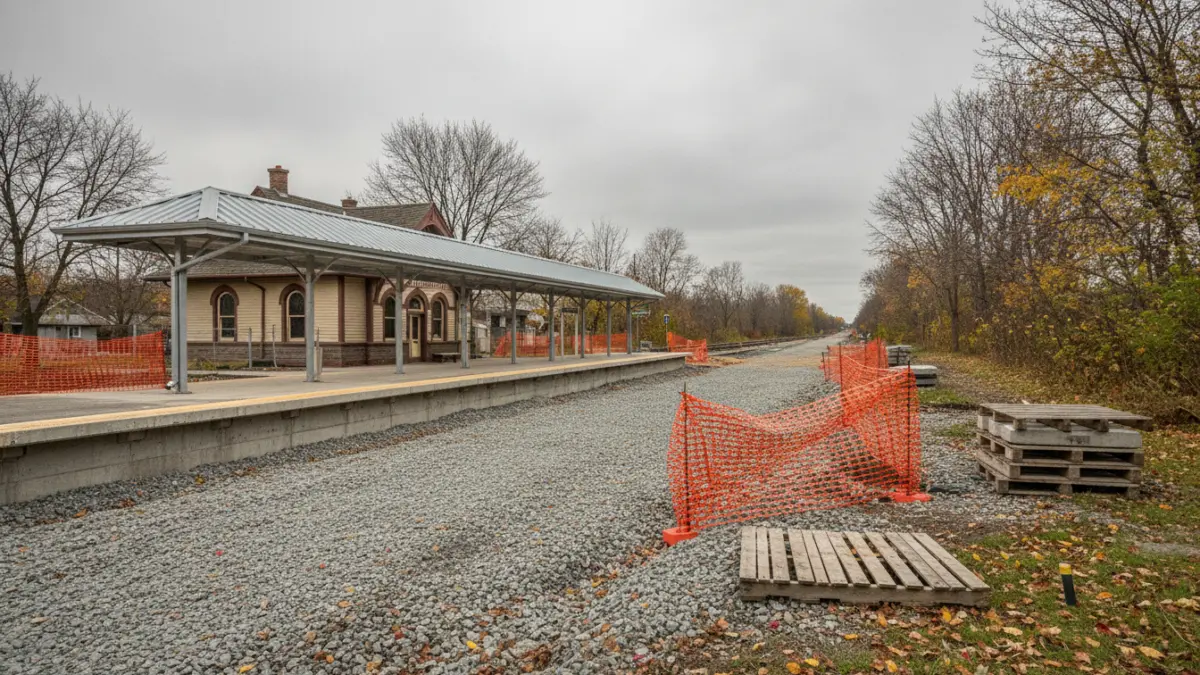
Aurora GO is at 121 Wellington Street East, east of Yonge Street, on the Barrie line. It is in the middle of a major rebuild. GO Transit lists the work as a new west platform, a second track, upgraded signals, a new pick-up and drop-off area, a new exit at Berczy Street, a pedestrian tunnel with an elevator, and improvements to the existing east platform. GO says the work is being done in phases, with major works expected to be complete by December 2027.
Construction has changed how the station works day to day. GO’s construction page says the west parking lot is closed, the parking structure has 847 spaces on a first-come, first-served basis, and an overflow lot at 9 Scanlon Court has 380 spaces about a 15-minute walk away. It also warns that the active train platform is roughly a 10-minute walk from the station building. GO points riders to Bloomington GO on the Richmond Hill line, about a 10-minute drive away, as an alternative with more than 1,000 parking spaces.
How often trains run
Service on the Barrie line changes often, so check GO’s current schedule before you count on a particular train. In October 2025, Metrolinx added two rush-hour trips between Aurora and Union, including a 7:20 a.m. departure from Aurora due at Union at 8:14 a.m., making all stops.
Longer term, Metrolinx told the Aurora GO Construction Liaison Committee in May 2026 that its Barrie line plan prioritizes 30-minute all-stop service to Aurora, and that its 15-minute electrified service goal at Aurora refers to the peak direction. It said double tracking under the current Aurora GO project is expected by the end of 2027, but it did not give a date for more frequent service, which also depends on other projects along the line. Our guide to living near a GO station covers One Fare and GO parking in more detail.
Viva and local buses
York Region Transit’s Viva Blue runs along Yonge Street through Aurora, between Newmarket Terminal and Finch Terminal in Toronto, with stops at Orchard Heights, Wellington, Golf Links, Henderson and Bloomington. Local YRT routes in town include 32 Aurora South, 33 Wellington-Leslie, 54 Bayview, 96 Keele-Yonge and 98 Yonge. Check YRT for current hours, as some local routes run only at rush hour.
Driving
Highway 404 is just east of town and Highway 400 is farther west, both reached by east to west roads such as Wellington Street. Drive times to Toronto change too much by hour to quote. Test the trip at the time you would actually make it.
Downtown, heritage and daily life
Downtown and Aurora Town Square
Aurora’s historic downtown runs along Yonge Street around Wellington Street. The Town’s Cultural Precinct, the three blocks bounded by Mosley Street, Metcalfe and Church Streets and Yonge Street, holds the highest concentration of heritage buildings and cultural landscapes in the core.
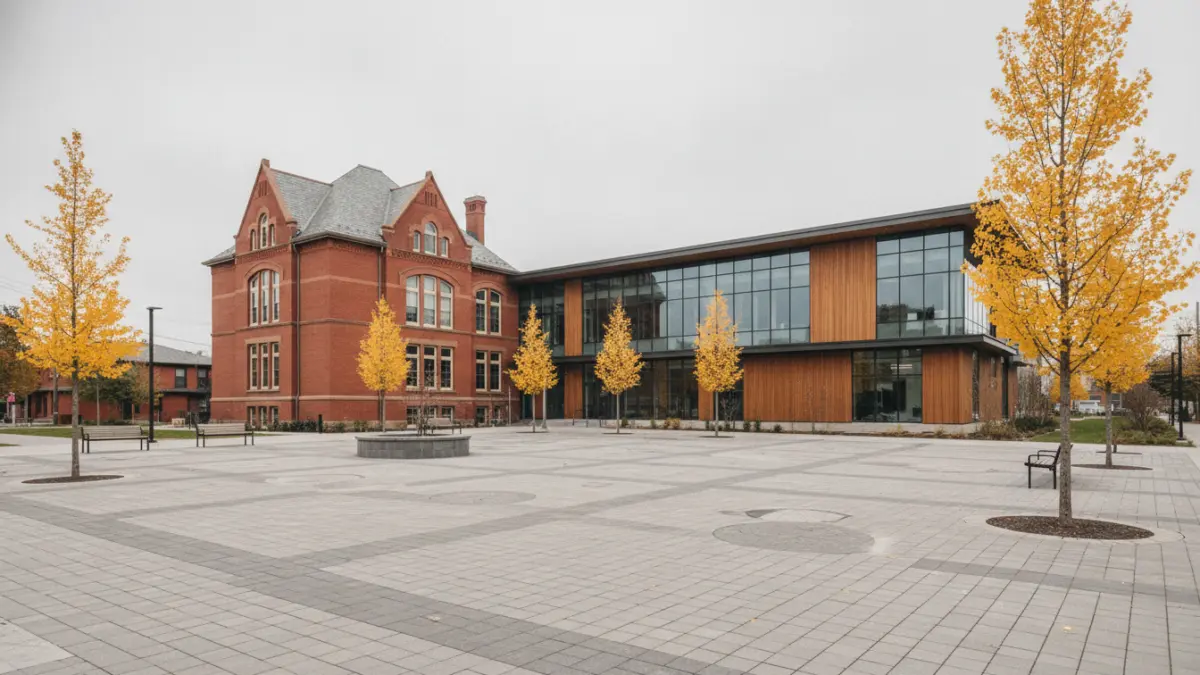
Aurora Town Square opened in September 2024 at 50 Victoria Street. The project added a performance hall, studios and space for the Aurora Museum & Archives to the 1885 Church Street School building, created an outdoor square, and renovated the Aurora Public Library at 15145 Yonge Street, which an indoor bridge now links to the new addition. The Aurora Farmers’ Market is held at Town Park on Wells Street; check the market’s dates for the coming season.
Northeast Old Aurora heritage district
Council designated Northeast Old Aurora as a Heritage Conservation District under Part V of the Ontario Heritage Act by By-law 4804-06.D on June 13, 2006, and adopted its district plan the same day. The Town’s heritage pages say the plan received final boundary approval from the Ontario Municipal Board on November 9, 2006, and that it is the only heritage conservation district in Aurora. The Ontario Heritage Trust describes it as a mostly residential area of 165 properties from the 19th and early 20th centuries, northeast of Yonge and Wellington.
If you buy in the district, the Town requires approval for exterior alterations, new construction and demolition. Some approvals have been delegated to Town heritage staff, but expect a permit process before you change windows, porches or cladding, or build an addition. Outside the district, the Town keeps a register of other designated and listed heritage properties.
Recreation and parks
The Town runs two main recreation centres. The Aurora Family Leisure Complex at 135 Industrial Parkway North has a pool, an ice rink, squash courts, a fitness centre, a walking track and a gym. The complex at 1400 Wellington Street East, long known as the Stronach Aurora Recreation Complex and listed as the Aurora Recreation Complex in recent Town schedules, has two ice rinks, three pools and a gymnasium. The Aurora Community Centre has another ice pad.
Sheppard’s Bush, at 93 Industrial Parkway South, covers about 63 acres with trails and sports fields, and the Tim Jones Trail and Arboretum follows a 126-acre valley corridor between Wellington Street East and St. John’s Sideroad. The Town’s parks map lists the rest.
Health care and schools
The nearest hospital is Southlake Regional Health Centre in neighbouring Newmarket. Public schools are run by the York Region District School Board and Catholic schools by the York Catholic District School Board, with French-language boards also serving the area. Boundaries change as new neighbourhoods open, so confirm the school for an exact address with each board before you buy.
What is changing
A new Official Plan
Aurora Town Council adopted an updated Official Plan in January 2024, according to the Town’s policy planning page. The update included a review of the Aurora Promenade Secondary Plan for the Yonge and Wellington corridors and the designation of the Aurora GO station area as a Major Transit Station Area, where provincial policy expects more homes and jobs near transit.
Downtown Community Planning Permit System
On January 27, 2026, Council approved a Downtown Community Planning Permit System, according to the Town’s meeting highlights. It combines zoning amendments, minor variances and site plan approval into one permit process for the historic downtown, with rules set in advance. The Town describes it as a way to guide growth in the core while protecting its character. A councillor who opposed it raised concerns that it reduces public notice and debate on individual projects. If you are buying downtown, read the by-law’s rules for your block, because they set what can be built next door.
Rail crossings and noise near the GO line
The rail line crosses Wellington Street East and Centre Street at grade near the station. Metrolinx says it is working with the Town and York Region on a traffic impact study of those crossings, including how often the gates lower while trains sit at the station. Metrolinx also told the liaison committee that noise walls are not planned at Aurora GO under the current project, and that the Town has not applied for whistle cessation. If you are looking at a home near the tracks, our guide to buying a home near a railway line covers setbacks, noise and warning clauses.
Our guide to researching a GTA neighbourhood before you buy shows how to look up planning applications near a property.
Property tax and land transfer tax
Property tax
The Town of Aurora’s 2026 residential tax rate is 0.873953%. That total is made up of 0.328541% for the Town, 0.392412% for York Region and 0.153000% for education. The Town’s 2026 budget raised the Town levy by 2.2%, an increase the Town put at $56.94 a year for a home assessed at $800,000. Our GTA property tax rates guide compares Aurora with other municipalities.
| MPAC assessed value | Estimated yearly tax |
|---|---|
| $600,000 | $5,243.72 |
| $700,000 | $6,117.67 |
| $800,000 | $6,991.62 |
Ontario assessments are still based on January 1, 2016 values, not today’s prices, so ask for the seller’s latest tax bill. The Town bills an interim and a final bill, each with two instalments. It also offers pre-authorized payment in 11 monthly withdrawals or on the instalment due dates, plus a 12-month arrears plan. Water, wastewater and stormwater are billed separately from property tax.
Land transfer tax
Aurora is outside Toronto, so buyers pay only the Ontario land transfer tax.
| Price | Ontario LTT | For eligible first-time buyers |
|---|---|---|
| $1,110,000 (January to October 2026 median, all types) | $18,675 | $14,675 |
| $1,131,500 (October 2026 median, all types) | $19,105 | $15,105 |
| $1,282,500 (October 2026 detached median) | $22,125 | $18,125 |
The first-time buyer column applies Ontario’s refund of up to $4,000. Our land transfer tax guide for first-time buyers explains who qualifies.
This is general information, not tax, legal or mortgage advice.
Checks before you buy
- Distance to the tracks. Homes near the Barrie line will see more trains as service grows, and noise walls are not planned at the station. Visit at rush hour and ask your lawyer about warning clauses on title.
- Heritage status. In Northeast Old Aurora and on older downtown streets, ask whether the home is in the heritage district or on the Town’s register before you plan changes.
- Valleys and ravines. Homes backing onto creeks or ravines may be in a conservation authority’s regulated area, which affects decks, pools and additions. Our floodplain map guide shows how to check.
- Station parking. If you plan to commute by GO, look at where you would park during construction, or price in the drive to Bloomington GO.
- Downtown growth. Near Yonge and Wellington, read the Community Planning Permit rules for nearby lots so new buildings do not surprise you.
Comparing Aurora with other York Region towns? See our guides to living in Thornhill and Maple vs Woodbridge, the Richmond Hill real estate guide for the town just south, or browse all our city guides.
FAQ
How much do homes cost in Aurora, Ontario?
In October 2026, Aurora homes of all types sold for an average of $1,170,302 and a median of $1,131,500 across 50 sales, according to TRREB. Detached houses averaged $1,395,203. The MLS Home Price Index composite benchmark was $1,096,900, down 7.37% from a year earlier.
Does Aurora have a GO train?
Yes. Aurora GO at 121 Wellington Street East is on the Barrie line to Union Station. The station is being rebuilt with a second track, a new west platform and a pedestrian tunnel, with major work expected to finish in December 2027. Check GO’s schedule for current service.
Is Aurora getting more frequent GO service?
Metrolinx’s Barrie line plan prioritizes 30-minute all-stop service to Aurora, with 15-minute peak-direction service as a longer-term goal. Metrolinx has not published a date. Double tracking under the current Aurora GO project is expected by the end of 2027.
What is the property tax rate in Aurora?
The 2026 residential rate is 0.873953%: 0.328541% for the Town, 0.392412% for York Region and 0.153000% for education. A home assessed at $700,000 would pay about $6,118 a year.
Does Aurora have a heritage district?
Yes. Northeast Old Aurora was designated a Heritage Conservation District in 2006. It covers about 165 mostly residential properties northeast of Yonge and Wellington, and owners need Town approval for exterior alterations, new construction and demolition.
Do buyers in Aurora pay Toronto’s land transfer tax?
No. Aurora is in York Region, so buyers pay only the Ontario land transfer tax. At the October 2026 median of $1,131,500, that is $19,105, or $15,105 for eligible first-time buyers.
Sources
- Toronto Regional Real Estate Board, Market Watch, October 2026 (Aurora and York Region tables: all home types, by home type, year to date and MLS Home Price Index)
- Town of Aurora, 2026 Property Tax Rates schedule; 2026 Budget Executive Summary (adopted December 7, 2025); Property Taxes and Pre-authorized Payment Plan pages
- GO Transit, Aurora GO Station Improvement construction page
- Metrolinx, Aurora GO Construction Liaison Committee meeting minutes, May 14, 2026; Additional rush hour service for the Barrie line this fall, October 14, 2025
- York Region Transit, route information for Aurora
- Town of Aurora, Policy Planning page (Official Plan and Downtown Community Planning Permit By-law); Highlights of the Meeting of Council, January 27, 2026; Aurora Promenade and Aurora Cultural Precinct pages
- Town of Aurora, By-law 4804-06.D and By-law 4809-06.D (Northeast Old Aurora Heritage Conservation District), via the Ontario Heritage Trust; Town of Aurora heritage conservation district pages; Ontario Heritage Trust, Northeast Old Aurora HCD example
- Town of Aurora, Aurora Town Square pages; recreation facility and parks pages
- Town of Aurora Museum & Archives, The Story of Aurora; Ontario Heritage Trust, The First Steam Train 1853 plaque; The Canadian Encyclopedia, Aurora
- Government of Ontario, land transfer tax rates and first-time homebuyer refund
Images: AI-generated illustrations created for this guide. They do not show real properties.
Local Toronto, HomeLife Landmark Realty Inc., Brokerage.