Verified November 26, 2026 against Electrical Safety Authority, Condominium Authority of Ontario, City of Toronto, Toronto Parking Authority, City of Mississauga and City of Brampton pages. Fees and rules change, so confirm before you book an installer.
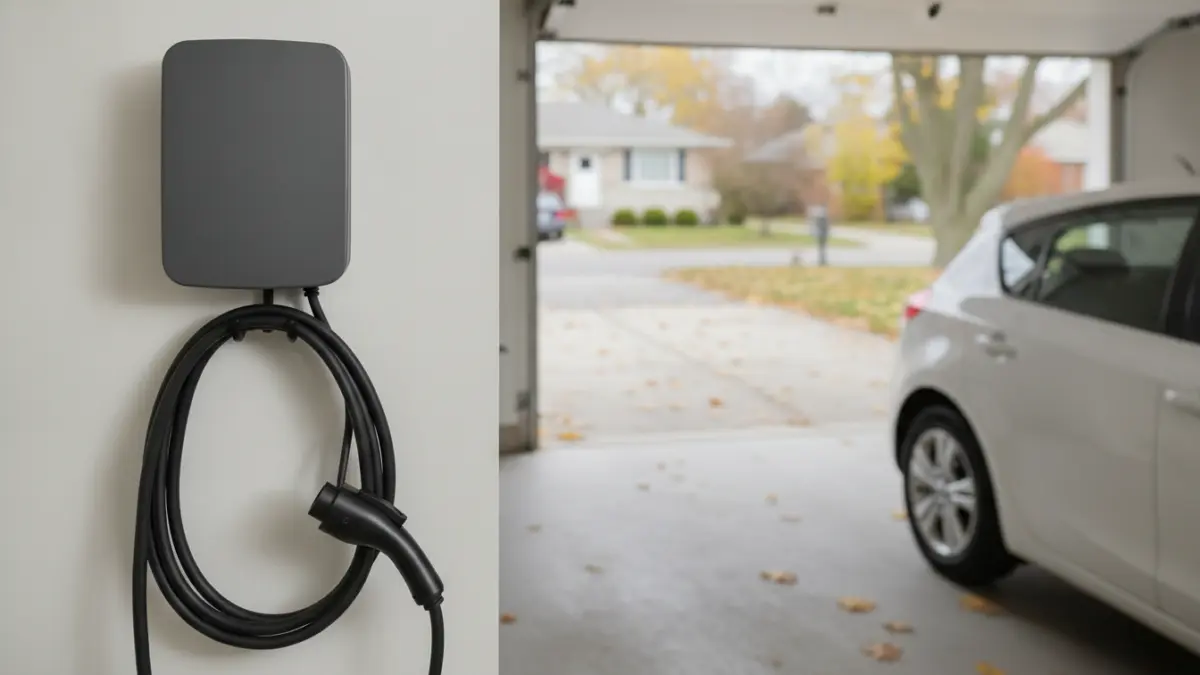
Short answer: Yes, you can install an EV charger at a house in Toronto, Mississauga or Brampton, but every installation needs an electrical permit (a notification of work) filed with the Electrical Safety Authority before the work starts. A Licensed Electrical Contractor normally files it and gives you an ESA Certificate of Acceptance when the job passes. What you cannot do in Toronto is run a charging cord across the public sidewalk to a car parked on the street. In a condo, an Ontario regulation gives owners a set process to apply, and the board has 60 days to answer.
More GTA buyers now ask whether they can charge a car at home before they ask about anything else on a listing. The answer depends less on the city you live in than on the kind of home you have. A detached house with a garage is simple. A semi with only street parking is harder. A condo has its own legal process. Here is how each case works, using the rules the province and the three largest cities actually publish.
The rules at a glance
| Your situation | What applies | Who decides |
|---|---|---|
| House with a garage or driveway | ESA notification of work before installation; work must meet the Ontario Electrical Safety Code | Electrical Safety Authority |
| Doing the wiring yourself | Allowed only in your own home, with your own ESA notification and inspection; friends and relatives cannot do it for you | Electrical Safety Authority |
| Street parking only, Toronto | No private cords across sidewalks and no private chargers on City streets; use public chargers | City of Toronto |
| Condo unit owner | Written application under Ontario Regulation 48/01; 60 days for a response; agreement within 90 days | Condo board, under the Condominium Act |
| Parking in a public EV space | Must be an EV that is plugged in and charging; $75 Toronto, $125 Mississauga and Brampton | City parking by-laws |
The ESA permit and who can do the work
The Electrical Safety Authority is clear on this point: all EV charger installations require an electrical permit filed before work starts. ESA calls it a notification of work. It is separate from a building permit issued by your city, and it creates a permanent record of the electrical work on your home.
If you pay someone to do the installation, Ontario law says it must be a Licensed Electrical Contractor (LEC) holding an ECRA/ESA licence. The contractor files the notification, books the inspection and hands you the ESA Certificate of Acceptance once the work is accepted as meeting the Ontario Electrical Safety Code. ESA suggests asking for copies of both the permit and the certificate, because insurers and future buyers may ask for them. You can check a contractor’s licence with ESA’s online contractor locator before you sign anything.
Homeowners can do electrical work in their own home, but ESA sets limits. You must file your own notification before you start, get the work reviewed before you cover it up, and you cannot have friends, family members or neighbours do the work for you. ESA notes that notification fees for many small residential projects can be under $100, though the fee depends on the job. For a 240 volt circuit that will run for hours every night, most owners hire a licensed contractor.
Skipping the permit is common enough that ESA ran a safety blitz on it. In September 2023 it reported finding more than 400 cases of EV charger work done without an ESA permit in Toronto.
Check the charger itself, too. ESA says an EV charging unit sold or used in Ontario must carry a recognized Canadian certification mark. A cheap unit without one can fail inspection even if the wiring is perfect.
Most simple charger jobs only involve the ESA side. If the charger is part of a bigger project, such as a new garage or a detached structure, check with your city’s building department as well. Our guide to 25 home projects and which ones need a permit covers the other common cases in Toronto, Mississauga and Brampton.
Level 1 or Level 2, and your electrical panel
ESA describes three levels of charging. Only the first two are meant for homes.
| Level | Power | Home use | ESA notes |
|---|---|---|---|
| Level 1 | Standard 120 volt household outlet | Yes | Slowest option; ESA’s brochure puts it at about 8 km of range per hour |
| Level 2 | About 240 volts and 30 amps, similar to a stove or dryer | Yes | Faster; needs a dedicated circuit and an ESA permit |
| Level 3 (DC fast) | Commercial equipment | No | Designed for commercial sites, not suitable for homes |
A Level 2 charger adds a large load to your panel. ESA advises having a licensed contractor check whether your panel can carry it. If the home needs a bigger electrical service, that involves your local utility, such as Toronto Hydro or Alectra in Mississauga and Brampton, as well as the contractor. Older houses with smaller services are the ones most likely to need this, so ask about panel capacity before you commit to a car purchase date.
Placement matters more than people expect. ESA suggests mapping out how you park so the charger sits close to the car’s charge port, rather than stretching a cable across the garage. Outdoor installations must use equipment and wiring rated for outdoor use.
No driveway: cords, the curb and public chargers
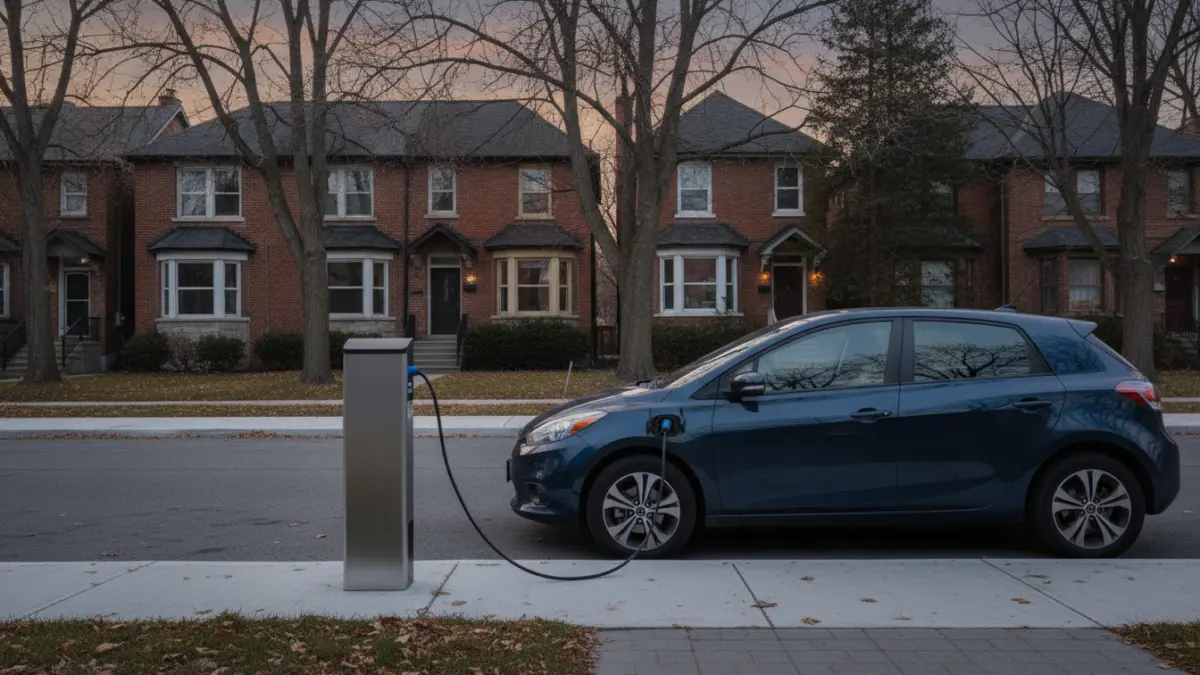
This is where many Toronto owners get stuck. If you park on the street with a permit, the City of Toronto does not allow you to run an extension cord across the sidewalk to your car, and it does not allow private chargers on the public boulevard.
City Council asked staff to look at both ideas, and an April 19, 2023 staff report recommended against them. The report listed snow clearing equipment damaging cables, trip hazards from cord covers, the risk of shock from damaged cables, and the need to amend the City’s streets and sidewalks by-law (Chapter 743). It also said private chargers next to on-street spaces would give individuals a form of dedicated access to public curb space, which the City does not provide. The same report estimated that about 80% of EV owners charge at home and that about 5% of Toronto residents rely on on-street permit parking.
The City’s answer for these households is public charging. Toronto Parking Authority, which runs Green P, operates on-street Level 2 chargers on residential streets across the old city and in many Green P lots. On a Toronto residential street with a charger, the designated EV spaces allow up to 12 hours for permit holders and 3 hours for others, and the car must stay plugged in. Your regular Toronto overnight street parking permit rules still apply in those spaces.
If you have no driveway but do have front yard space, a licensed front yard parking pad may be an option in some parts of Toronto. Our guide to front yard parking pads in Toronto explains where the City still accepts applications and what the polls and fees involve.
City-owned chargers in Toronto, Mississauga and Brampton
Each city runs its own public chargers with its own prices. These are the published rates for City-owned stations only. Private networks at malls, gas stations and dealerships set their own prices.
| Toronto (Green P) | Mississauga | Brampton | |
|---|---|---|---|
| Level 2 price | $2.00 per hour; on-street $6.00 flat from 9 p.m. to 6 a.m.; off-street $6.00 overnight maximum | $0.30 per kWh at most sites; $2 per hour at Hazel McCallion Central Library | $1.00 per hour for the first 3 hours, then $5.00 per hour |
| Fast charging | $15.00 per hour (50 kW) or $20.00 per hour (100 kW) at off-street sites | No City-owned Level 3 stations | City stations are Level 2 |
| Parking | Paid separately | Paid separately in municipal lots | Varies by facility |
| Idle or time rules | Must be actively charging; posted limits apply | $5 per hour idle fee from 30 minutes after charging ends (none 10 p.m. to 8 a.m. where overnight parking is allowed); 10-hour limit | Must be plugged in to park |
| Fine for misuse | $75 | $125 | $125 |
Mississauga lists 48 City-owned Level 2 chargers across six sites, including Burnhamthorpe and Carmen Corbasson community centres, Marina Park, the Sheridan College downtown campus lot and Streetsville municipal lot 21. Brampton says its Level 2 stations can fully charge a vehicle in about 3 to 6 hours, depending on the car. Toronto Parking Authority says it plans to reach more than 100 on-street and more than 400 off-street stations by the end of 2026.
In all three cities, parking a gas car in a signed EV space, or parking an EV there without plugging in, can bring a ticket. Brampton notes that these fines come from Ontario’s Electric Vehicle Charging Act, 2019, which took effect on January 1, 2021.
Condo owners: the Ontario application process
Before 2018, a condo owner who wanted a charger in their parking spot could be stalled indefinitely. Changes to Ontario Regulation 48/01 under the Condominium Act now set out a process, and the Condominium Authority of Ontario publishes free templates for the application and the board’s response.
| Step | What happens | Time limit |
|---|---|---|
| 1. Application | Owner gives the corporation a signed written application with their address for service and the drawings, specifications and information for the installation | None |
| 2. Board decision | Board approves, approves with a different location or method, or rejects | 60 days, or longer if both sides agree |
| 3. Grounds to refuse | Only if a qualified professional’s report or opinion says it would break the law, harm structural integrity, or create a health and safety risk; the owner gets a copy | With the decision |
| 4. Agreement | Written agreement on costs and responsibilities, registered on the title of the owner’s unit | Within 90 days of approval |
| 5. Disputes | Private mediation and arbitration; if not raised in time, the application is treated as abandoned | Within 6 months |
The owner normally pays for an installation they apply for, unless the agreement says otherwise. A board can also propose a different location or method, but not one that puts unreasonable extra costs on the owner. The agreement does not take effect until it is registered on title, which matters if you plan to sell.
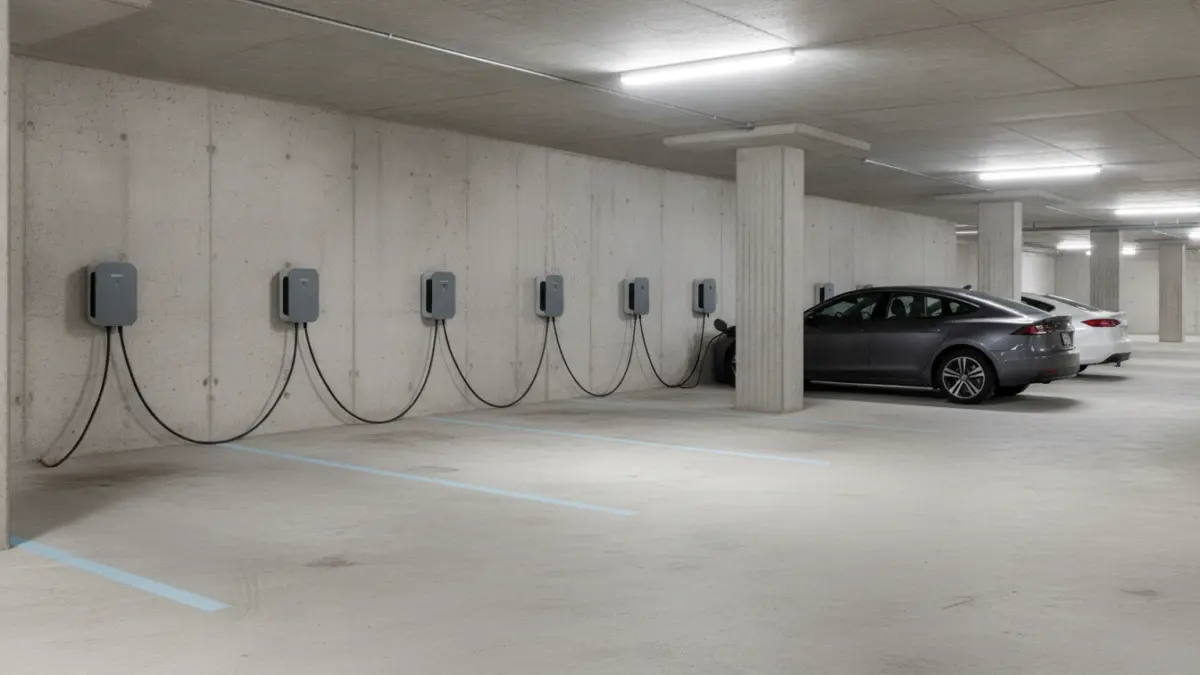
Boards can also install shared chargers for the whole building. They can do this without an owners’ vote if the cost is under 10% of the annual budgeted common expenses and the board believes owners would not see it as a significant loss of use or enjoyment. They still have to give owners at least 60 days’ notice. Larger or more disruptive projects let owners requisition a meeting and vote. Those costs are common expenses, so they show up in condo fees.
Building electrical capacity is the real limit in many older towers. If you are buying a condo and plan to drive electric, ask the building whether any chargers exist, whether there is a waiting list, and how EV electricity is metered and billed. The status certificate and board minutes often show whether an EV project has been discussed or budgeted.
What overnight charging costs on the ultra-low plan
Ontario’s ultra-low overnight (ULO) price plan suits drivers who charge at night. Since November 1, 2026, the ULO price is 3.7 cents per kWh every day from 11 p.m. to 7 a.m. The on-peak price on the same plan is 37.7 cents per kWh on weekdays from 4 p.m. to 9 p.m., so charging at the wrong time costs about ten times more per kWh. We covered the full price tables in our story on the November 2026 electricity price change.
ESA suggests budgeting with your car’s rated energy use in kWh per 100 km. The table below uses example figures only, to show the arithmetic. It covers the electricity commodity price and leaves out delivery, regulatory charges, HST and the Ontario Electricity Rebate, which all change the final bill.
| Weekly driving (example) | Car uses 18 kWh/100 km | Car uses 25 kWh/100 km |
|---|---|---|
| 150 km | 27 kWh, about $1.00 at ULO, $10.18 at ULO on-peak | 37.5 kWh, about $1.39 at ULO, $14.14 at ULO on-peak |
| 250 km | 45 kWh, about $1.67 at ULO, $16.97 at ULO on-peak | 62.5 kWh, about $2.31 at ULO, $23.56 at ULO on-peak |
| 400 km | 72 kWh, about $2.66 at ULO, $27.14 at ULO on-peak | 100 kWh, about $3.70 at ULO, $37.70 at ULO on-peak |
Most Level 2 chargers and many cars let you schedule charging to start at 11 p.m. Charging at home also means a power cut stops charging, so it helps to know who to call during a GTA power outage and what to do with a charger when the power comes back.
Buying or selling a home with a charger
A properly installed Level 2 charger is a useful feature on a listing, but buyers should check the paperwork as closely as the hardware.
- Ask for the ESA Certificate of Acceptance. ESA says it can matter for insurance and resale. If the seller cannot produce one, your lawyer or inspector can help you decide whether to ask for an ESA record search or a holdback.
- Check whether the charger is a fixture. A hardwired unit is usually treated as part of the house, while a plug-in unit may not be. Name it in the offer either way.
- Look at the panel. Note the panel size and whether there is room for other loads you plan to add, such as a heat pump or a basement suite.
- In a condo, read the registered agreement. An owner-installed charger comes with an agreement on title that sets out who pays for upkeep, insurance and removal.
- No driveway? Check the nearest public chargers and their hours before you assume street charging will work for you.
Our guide to buying a home with unpermitted renovations explains how ESA records and missing permits are usually handled in an offer. If you are selling and want to know how the market will value your home, including features like a charger, start with a free home evaluation.
Shopping for a home where you can charge? Browse current listings on our Toronto, Mississauga and Brampton pages, or tell us what you need on our buy a home page.
FAQ
Do I need a permit to install an EV charger at home in Ontario?
Yes. The Electrical Safety Authority says every EV charger installation needs an electrical permit, called a notification of work, filed with ESA before the work starts. A Licensed Electrical Contractor normally files it and gives you an ESA Certificate of Acceptance when the work passes inspection.
Can I install a Level 2 charger myself?
Only in your own home, and only if you file your own ESA notification before you start and have the work reviewed before you cover it. ESA says friends, family members or neighbours cannot do the electrical work for you. Anyone you pay must be a Licensed Electrical Contractor.
Can I run a charging cord across the sidewalk in Toronto?
No. A 2023 City of Toronto staff report recommended against allowing cords across sidewalks or private chargers on City streets, citing snow clearing, trip hazards and electrical safety. Residents without a driveway are directed to public on-street and Green P chargers instead.
Can my condo board refuse my EV charger?
Only for limited reasons. Under Ontario Regulation 48/01, the board must respond within 60 days and can refuse only if a qualified professional finds the installation would break the law, harm the building’s structure, or create a health and safety risk. It can also propose a different location or method that does not add unreasonable costs.
How much does public charging cost in Mississauga and Brampton?
Mississauga’s City-owned Level 2 chargers cost $0.30 per kWh at most sites, with a $5 per hour idle fee starting 30 minutes after charging ends. Brampton charges $1 per hour for the first three hours and $5 per hour after that. Parking fees can apply on top in both cities.
Can I park in an EV charging space without charging?
No. In Toronto, Mississauga and Brampton, a signed EV space is only for an electric vehicle that is plugged in. Fines are $75 in Toronto and $125 in Mississauga and Brampton, and Mississauga also has a 10-hour limit at City chargers.
Sources
- Electrical Safety Authority, Electric Vehicles and Charging Systems (homeowner page), accessed November 25, 2026; Charge Safely EV brochure; Do-It-Yourself (DIY) Electrical Work page.
- Electrical Safety Authority, news release, ESA Ramps Up Electric Vehicle Charging Safety in Ontario, September 6, 2023.
- Condominium Authority of Ontario, CAO Guide on Electric Vehicle Charging Systems, updated April 11, 2024, and EVCS application and response templates; Ontario Regulation 48/01 under the Condominium Act, 1998.
- City of Toronto, staff report, Options for Permitting Private Installation of Electric Vehicle Charging Infrastructure on Public Streets, April 19, 2023.
- City of Toronto, staff report, On-Street Electric Vehicle Charging Stations, Parking Amendments (Delegated Locations), November 4, 2025; Toronto municipal parking penalty amendments (2024).
- Toronto Parking Authority (Green P), EV Charging page, updated September 30, 2026.
- City of Mississauga, City-owned EV charging stations, modified September 5, 2025.
- City of Brampton, Electric Vehicle Charging Stations page and Public EV Charging Guidelines, accessed November 25, 2026.
- Ontario Energy Board electricity prices effective November 1, 2026, as reported in Local Toronto’s November 2026 electricity price story.
This guide is general information, not legal or electrical advice. Confirm requirements with ESA, your condo corporation or your city before you install.
Images: AI-generated illustrations created for this guide. They do not show real properties.
Local Toronto, HomeLife Landmark Realty Inc., Brokerage.