Verified November 23, 2026 against utility and Electrical Safety Authority pages. Phone numbers and rules can change, so check your own bill or your utility’s website before you need them.
Short answer: If your neighbours have power, check your main breaker first. If the whole street is dark, report it to your local electricity utility, not the City: Toronto Hydro (416-542-8000, press 1) in Toronto, Alectra Utilities (1-833-253-2872, option 1) in Brampton, Mississauga, Vaughan, Markham, Richmond Hill and Aurora, and Hydro One (1-800-434-1235) in the areas it serves. Stay at least 10 metres from any downed line, never run a generator, barbecue or propane heater indoors, and keep the fridge and freezer closed.
Check whether it is just your home
Look out the window first. If streetlights and the houses around you still have power, the problem is probably inside your home. Toronto Hydro’s emergency guide says a tripped main breaker sits halfway between off and on. Its steps to reset it safely are:
- Unplug any appliance you think caused the overload.
- Use a flashlight to open your electrical panel.
- Flip the breaker firmly to off, then back to on.
- If it trips again, leave it off and call a licensed electrician. A repeat trip can point to a more serious fault.
- If your home still has fuses, replace the blown fuse.
If the whole street or block is out, report it to your utility. Many utilities already know about larger outages from smart meters and their own equipment, but a report helps when your outage is not on their map.
Who to call: GTA electricity utilities
Your city does not run your power. Each part of the GTA is served by a local distribution company, and the name is printed on your hydro bill. Here are the outage lines we confirmed for the larger GTA utilities.
| Utility | Where it serves in the GTA | Report an outage or downed line | Other ways to check or report |
|---|---|---|---|
| Toronto Hydro | City of Toronto | 416-542-8000 (press 1), 24/7 | Online outage map updated about every 10 minutes, online report form, mobile app, live outage chat Monday to Friday 7 a.m. to 7 p.m. |
| Alectra Utilities | Brampton, Mississauga, Vaughan, Markham, Richmond Hill and Aurora, plus other communities outside the GTA | 1-833-253-2872 (option 1), 24/7 | Outage map, online report form (attach a photo only if it is safe), web chat |
| Hydro One | Much of rural Ontario, including rural addresses around the GTA | 1-800-434-1235, 24/7 | Storm Centre outage map updated every 10 minutes, online reporting, mobile app, text reporting to 92887 (WATTS) |
| Milton Hydro | Town of Milton | 1-844-664-9376 (1-844-NOHYDRO) | Online outage map (view only, not for reporting) |
| Oakville Hydro | Town of Oakville | 905-825-9400 | Updates on the Oakville Hydro website |
Other GTA communities have their own utilities, such as Burlington Hydro, Newmarket-Tay Power, Elexicon Energy in parts of Durham Region and Orangeville Hydro. We did not confirm their outage numbers for this guide, so use the number on your bill or the IESO’s find-your-utility page. Save your utility’s number in your phone now, because looking it up on a dying battery is harder.
Call 911 first for anything life threatening, such as a fire, someone hurt or a person in contact with a wire. Hydro One also asks people who see a fallen line to report it to police as well as to the utility.
Downed lines and fallen trees
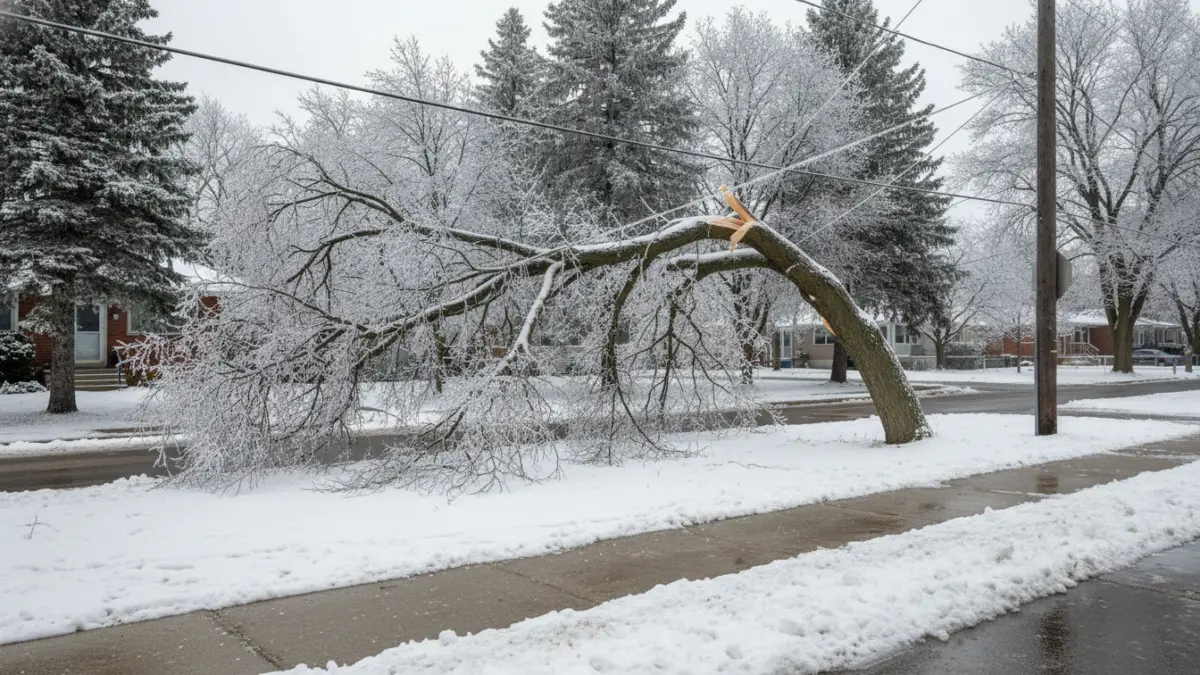
Treat every fallen wire as live. Toronto Hydro, Alectra and Hydro One all tell the public to stay at least 10 metres back, which is about the length of a school bus, and to report it right away. Do not try to move branches off a line, and keep children and pets away. A wire can look dead and still be energized.
Who deals with the tree depends on where it stands:
- Tree or branch on a power line: report it to your utility as a hazard. The utility makes the line safe.
- City-owned tree in Toronto (on the road allowance or boulevard): report fallen trees or branches to 311 once no wires are involved.
- Tree on your own property near a power line: Toronto Hydro advises hiring a licensed arborist rather than cutting it yourself.
For trees on the property line, or branches from a neighbour’s yard, our guide on cutting a neighbour’s tree branches in Ontario covers the rules.
How power is restored and why it can take time
Utilities do not restore homes in the order calls come in. Alectra describes its order this way: first make damaged areas safe, then restore critical sites such as hospitals, police, fire and EMS, seniors’ homes, pumping stations, sewage plants and communication centres. Next come dense neighbourhoods where crews can bring back the most customers in the least time. Smaller pockets and single homes come last.
Toronto Hydro lists five steps once an outage is reported: crews are dispatched, damage is assessed, repairs are made, equipment is tested and power is restored. Finding the cause can take time, especially with underground equipment, and crews drive the same congested roads as everyone else.
Estimated restoration times are only estimates. Alectra says they are revised as crews report back, and in severe weather it may not be able to give one at all. If your neighbours get power back and you do not, report it again. Your home may be on a separate piece of equipment, or the wires to your house may be damaged, which is covered below.
Staying warm and safe in a winter outage
If your home has a gas furnace, its fan and controls still need electricity, so an outage can mean no heat even with gas service on. Toronto Hydro’s winter advice is to pick one room, ideally on a higher floor because heat rises, seal gaps under doors with towels, wear loose layers and use extra blankets. Open curtains on sunny days and keep them closed otherwise.
The biggest danger is carbon monoxide. Toronto Hydro’s guide is clear on this:
- Never use a barbecue, propane heater or portable generator indoors or in a garage, covered porch or shed.
- Do not use a gas stove to heat your home.
- Use flashlights rather than candles. If you use candles, never leave them unattended.
- If you feel dizzy, sick, drowsy or short of breath, get to fresh air and seek medical help.
Plug-in CO alarms without a battery backup stop working when the power goes out. Our guide to smoke and carbon monoxide alarm rules for GTA homes explains what Ontario homes need and how to test them.
Pipes are the next risk. Toronto Hydro suggests keeping a few taps slightly open in winter so water keeps moving. If a pipe does freeze or burst, our guide on who pays for frozen or burst water pipes covers what the City and the owner are each responsible for.
Unplug electronics and turn the thermostat down so a power surge does not hit everything at once when service returns. Once power is back, turn essential appliances on gradually and wait 10 to 15 minutes before reconnecting electronics, as Toronto Hydro advises. If you rent, tell your landlord about any loss of heat. Our guide to landlord heat rules in Toronto, Mississauga and Brampton sets out the minimum temperatures in each city.
Food, medicine and medical equipment
| Item | What to do |
|---|---|
| Refrigerator | Keep it closed. An unopened fridge keeps food cold for about four hours. |
| Freezer | Keep it closed. A full freezer can keep food frozen for up to 48 hours. |
| Milk, meat, fish, eggs, leftovers | For a longer outage, move them into a cooler with ice. |
| Thawed food | Throw out anything that has been at 4°C or warmer for more than two hours. When in doubt, throw it out. |
| Medications | Keep a one-week supply of critical medications and a cooler bag with ice packs for ones that must stay cold. |
| Powered medical equipment | If someone at home relies on equipment such as a ventilator or dialysis machine, Toronto Hydro asks you to register so you are told about planned outages (416-542-8000 or its online form). Ask your own utility if it has a similar list, and plan a backup. |
Generator rules in Ontario
A generator can keep a fridge, sump pump or furnace running, but it can also kill. The Electrical Safety Authority (ESA) and Toronto Hydro set out the basics.
| Question | Portable generator | Permanent standby generator |
|---|---|---|
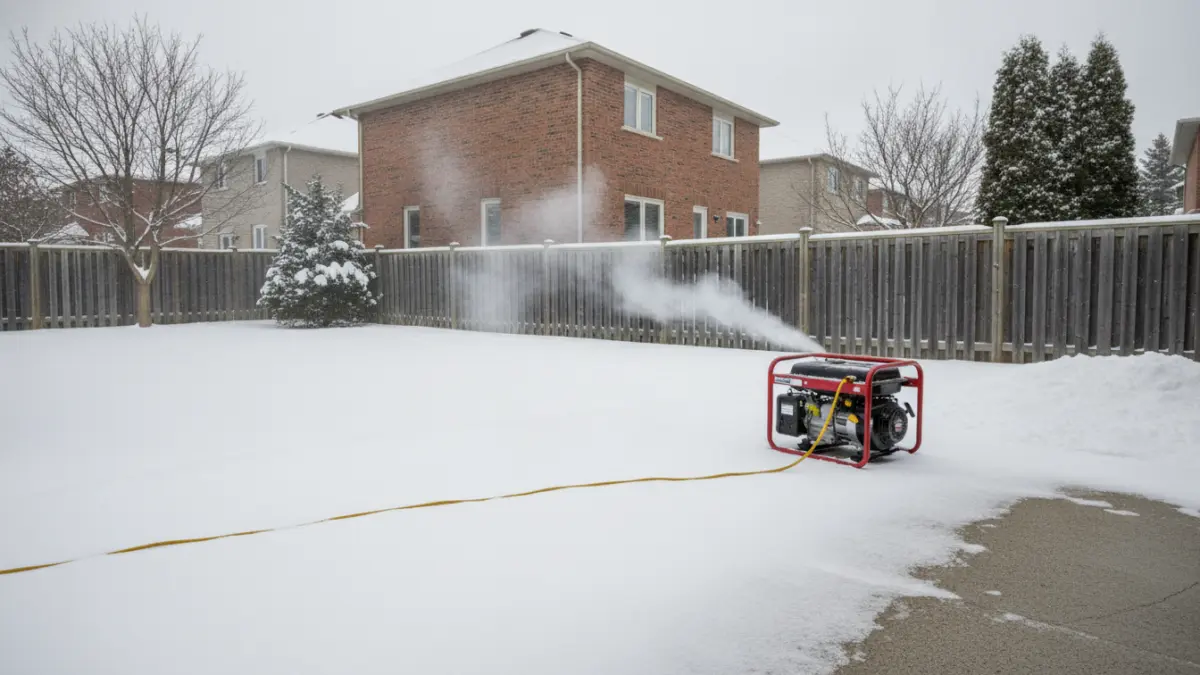
| Where it runs | Outdoors only, well away from windows and doors. Never in a house or garage. ESA says fans and open windows do not provide enough fresh air. | Installed outdoors to the manufacturer’s and code requirements. |
| How you connect | Plug appliances straight into the generator using a heavy-duty, three-prong outdoor cord rated for the load. Uncoil cords, since coiled cords can get very hot. Never plug a generator into a house outlet or wire it into the panel yourself. | Must have a transfer device so generator power cannot flow back into utility lines, which can endanger line crews. |
| Paperwork | None for plug-in use, but buy a unit with a recognized certification mark. | You must file a notification of work with ESA. ESA strongly recommends a Licensed Electrical Contractor. |
| Fuel | Let the engine cool at least 2 minutes before refuelling and use fresh gasoline (ESA). | Usually natural gas or propane, set up by the installer. |
| Water | Never connect a generator to appliances or wiring that have been damaged by water. | Same rule. Have flooded equipment checked by an electrician first. |
If you are buying a home with a standby generator already installed, ask the seller for the ESA paperwork for the installation. Our winter home inspection guide lists other systems worth checking in cold weather.
If the wires to your house are damaged
Ice and wind can rip the overhead service wire off a house or bend the metal mast it attaches to. This part surprises many owners: some of that equipment is yours to fix.
Alectra explains the split this way. With an underground service, Alectra owns the wires from the transformer to the meter base and the meter itself, while the owner is responsible for the meter base and the wiring from it into the house and panel. With an overhead service attached to a mast, the owner is responsible from the top of the mast into the electrical panel. Toronto Hydro’s guide says the same in plain terms: if the hardware and cables from the connection point down the side of your house are damaged, an ESA-approved electrician must repair them before power can be restored.
In practice, the utility may not reconnect you until a licensed electrician has made the repair. Alectra suggests keeping two or three licensed electricians’ numbers in your emergency contacts. ESA’s online contractor lookup can help you find one who is licensed.
Who pays for spoiled food or damaged electronics
Usually not the utility. Alectra’s damage claims page says that, under rules approved by the Ontario Energy Board, it is not liable for outages, low voltage or surges caused by severe weather or other events beyond its control, during repairs or maintenance, or during curtailment or blackout events. It offers no compensation for lost food, income or inconvenience unless there is gross or intentional fault, and it tells customers to call their insurer.
Where a claim does go ahead, Alectra says its insurer typically takes 60 to 90 days to review it. If Alectra is found negligent, it pays the lesser of the repair cost or the depreciated value of the item, not the replacement cost. Its own example: a $1,000 fridge with a 10-year life damaged after four years would likely be worth about $600. It also asks you to keep damaged items until the claim is decided, and it only reimburses an electrician’s bill when it told you to call one and the problem turned out to be its equipment.
Other utilities have their own claims rules, so check theirs. Home insurance policies vary on food spoilage and power surges. Read your policy or ask your broker before the next storm, not after. This is general information, not insurance or legal advice.
Get ready before the next storm
- Sign up for outage alerts through your utility’s online account. Toronto Hydro and Hydro One both send outage and restoration notices by text or email.
- Build a 72-hour kit. Toronto Hydro recommends 4 litres of water per person per day, ready-to-eat food, a manual can opener, flashlights and batteries, a wind-up or battery radio, power banks, a first aid kit, a week of critical medications and some cash, since ATMs may not work.
- Know your panel. Find the main breaker and the water shut-off before you need them.
- Check your alarms. Make sure CO and smoke alarms have working batteries or battery backup.
- Write down key numbers: your utility, a licensed electrician, your insurer and policy number, and 311 or your city’s service line.
- Charge phones and fill the car when a storm warning is issued, and secure outdoor furniture.
Hydro bills themselves are a separate topic. Our explainer on the Ontario Electricity Rebate change for November 2026 covers this winter’s prices.
Buying or selling in the GTA this winter? Questions about a home’s electrical service, generator or storm damage are worth asking before you firm up a deal. Start with our buyer guide, or get a free home evaluation if you are thinking of selling. City guides: Toronto, Mississauga, Brampton.
FAQ
Should I call 311 or my hydro company when the power goes out?
Call your electricity utility, such as Toronto Hydro at 416-542-8000 or Alectra at 1-833-253-2872. 311 handles City services such as fallen City trees and warming centres, not power restoration. Call 911 for fires, injuries or anyone in contact with a wire.
How far should I stay from a downed power line?
At least 10 metres, about the length of a school bus. Toronto Hydro, Alectra and Hydro One all give the same distance. Treat every fallen wire as live and report it right away.
How long will food last in the fridge and freezer without power?
Toronto Hydro says an unopened fridge keeps food cold for about four hours and a full, closed freezer can keep food frozen for up to 48 hours. Throw out thawed food that has been at 4°C or warmer for more than two hours.
Can I plug a portable generator into my house wiring?
No. Plug appliances directly into the generator with a proper outdoor cord. A generator connected to home wiring needs an approved transfer device, and ESA requires a notification of work for a permanent connection. ESA strongly recommends a Licensed Electrical Contractor for that work.
Will the utility pay for my spoiled food after an outage?
Usually not. Alectra, for example, says it is not liable for outages caused by severe weather or events beyond its control and offers no compensation for lost food unless there is gross or intentional fault. Check your home insurance policy instead.
Why does my neighbour have power when I do not?
Homes on the same street can be fed by different equipment, and crews restore the largest groups of customers first. The wires or mast on your own house may also be damaged. Report your outage again and check whether the service wire to your house is down.
Sources
- Toronto Hydro, Emergency Ready: Protect yourself and your loved ones during a power outage (emergency preparedness guide), and outage map and online tools pages, checked November 23, 2026.
- Alectra Utilities, Report a Power Outage, Hazard or Electrical Emergency; How We Restore Power; Who’s Responsible for Storm Damage Repairs; Damage Claims, checked November 23, 2026.
- Hydro One, What happens when the power goes out, Contact us, and Outage Alerts pages, checked November 23, 2026; Hydro One storm restoration news releases on reporting by text.
- Milton Hydro, outage map help page, checked November 23, 2026.
- Town of Oakville, Emergency alerts page (Oakville Hydro outage line), checked November 23, 2026.
- Electrical Safety Authority, Generator Safety page, checked November 23, 2026.
Images: AI-generated illustrations created for this guide. They do not show real properties.
Local Toronto, HomeLife Landmark Realty Inc., Brokerage.